You’ve done the work. You’ve watched what you eat, stayed consistent at the gym, maybe even lost a significant amount of weight. And yet, there they are — those stubborn love handles that just won’t budge, or the loose skin bunching up along your sides no matter what you do. It’s frustrating in a very specific, hard-to-explain way.
So you start looking into options. Liposuction comes up immediately; it’s practically a household word at this point. But then you stumble across something called a flankplasty, and now you’re down a rabbit hole at midnight, wondering what the difference actually is and which one makes sense for your situation.
Good news: you’re in the right place. This post breaks down both procedures honestly, side by side, so you can walk into a consultation already knowing the right questions to ask.
What Is a Flankplasty?
Let’s start here because it’s the one that confuses people most.
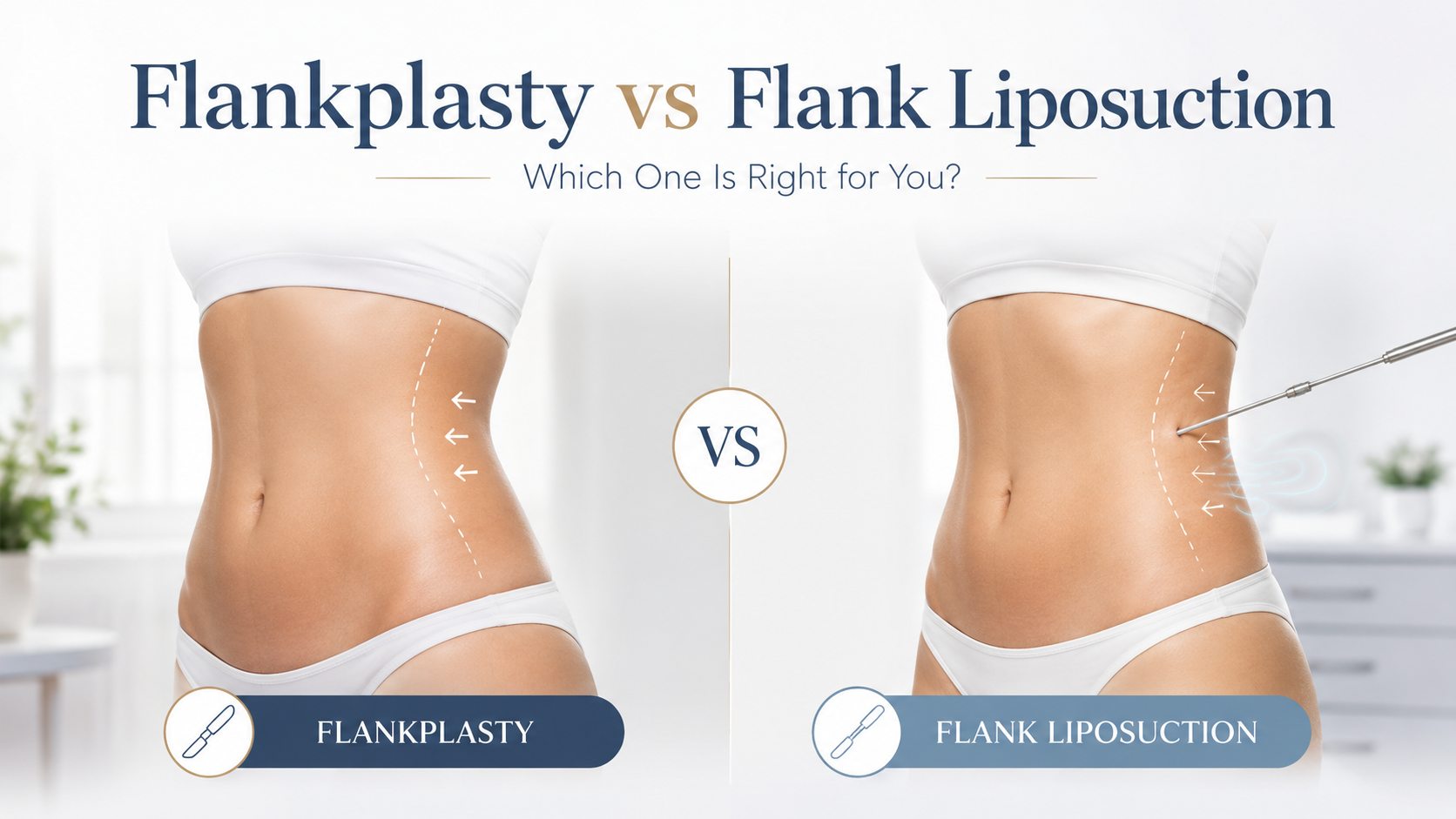
A flankplasty is a surgical procedure that removes excess skin and fat from the flank area — the sides of your torso, roughly between your lower ribs and hip bones. Think of it as a targeted body contouring surgery. The surgeon makes a carefully planned incision, excises the unwanted tissue, and then pulls the remaining skin taut before closing. The result is a smoother, firmer silhouette along the sides.
Here’s the thing most people don’t realize: flankplasty isn’t just about fat. It’s really about skin. The procedure is specifically designed for patients who have skin laxity in the flank region — meaning skin that has stretched, lost elasticity, and won’t snap back on its own. This happens after significant weight loss, after pregnancy, or sometimes just with age.
It’s worth noting that flankplasty is often performed alongside other body contouring procedures. A lower body lift, a tummy tuck (abdominoplasty), or a thigh lift might all be done in the same surgical session depending on the patient’s goals. Surgeons sometimes call this combination approach a circumferential body lift when it addresses the full midsection.
What is Flank Liposuction?
Flank liposuction is exactly what it sounds like. A surgeon inserts a thin cannula (a small tube) into the flank area through tiny incisions, then uses suction to remove localized fat deposits. The skin is left intact; the procedure simply reduces the volume underneath it.
Liposuction has been around since the 1980s and has gone through several evolutions since then. Today you’ll hear about tumescent liposuction, laser-assisted lipo (like SmartLipo), VASER ultrasound lipo, and more. Each technique has slightly different mechanisms, but the fundamental goal is the same: remove fat, sculpt the contour.
The appeal of flank lipo is real. Smaller incisions, no large scars, shorter recovery, and often a lower price point. For the right candidate, the results can be genuinely impressive.
But and this is the crucial part liposuction only works when the overlying skin has enough elasticity to contract after the fat is removed. Remove fat from skin that’s already loose, and you can actually make the problem worse. The skin has nothing left to hold it taut; it just droops more.
The Core Difference
Fat versus skin. That’s really the heart of it.
Flank liposuction addresses fat. Flankplasty addresses both fat and excess skin. If your flanks bother you because of volume (puffiness, a bulge that feels firm or squishy), lipo may be your answer. If they bother you because of texture or looseness (skin that folds over, hangs, or dimples regardless of your weight), a flankplasty is probably the more appropriate solution.
Of course, many patients have both issues — excess fat and loose skin together. That’s where it gets more nuanced, and where a board-certified plastic surgeon’s assessment becomes genuinely necessary rather than optional.
Who’s a Good Candidate for Each?
Flank Liposuction Makes Sense If You…
- Are close to your goal weight and have been stable there for at least six months
- Have good skin elasticity (the skin “bounces back” when pinched)
- Are bothered by localized fat deposits rather than skin redundancy
- Have realistic expectations — lipo sculpts; it doesn’t dramatically change your body shape or act as a weight loss tool
- Don’t smoke, or are willing to stop well ahead of surgery
Younger patients, or those who haven’t had significant weight fluctuations, often fall into this category. The skin is still resilient enough to retract after fat removal, which is the key factor.
Flankplasty Is More Appropriate If You…
- Have had massive weight loss (bariatric surgery patients, for example, are classic candidates)
- Carry excess, overhanging skin along your sides that no amount of exercise will resolve
- Have skin that stays folded or wrinkled even when you stand upright
- Have already had liposuction and still have residual skin laxity
- Want to address skin quality, not just volume
Patients in their 40s, 50s, or beyond often find they’re better suited for flankplasty simply because skin elasticity naturally decreases with age. That’s not a rule, just a tendency worth knowing.
Recovery
This is where the two procedures diverge pretty dramatically, and it matters more than most people anticipate when they’re first researching their options.
Flank liposuction recovery is relatively manageable. Most patients take about a week off work (desk jobs especially), wear a compression garment for four to six weeks, and deal with some swelling and bruising that fades over several weeks. You’re usually cleared for light activity within two weeks and more strenuous exercise by six weeks. Full results — meaning all swelling resolved — can take three to six months to fully show.
Flankplasty recovery is a bigger undertaking. There’s no soft way to say this: it’s a more involved surgery with a more involved recovery. Expect two to three weeks before returning to sedentary work, four to six weeks before resuming normal daily activities, and two to three months before higher-intensity exercise. Drainage tubes may be placed post-operatively. Swelling is more pronounced and lingers longer. You’ll need someone to help you at home for at least the first week.
The incisions from a flankplasty also leave scars, and it’s worth having an honest conversation with your surgeon about scar placement and what to expect. Good surgeons place incisions strategically — often within the waistband of underwear or swimwear — but scars do take time to fade and may never become completely invisible.
Flankplasty Before and After
Here’s what patients consistently report when looking at flankplasty before and after comparisons: the change in silhouette is often striking, especially for post-weight-loss patients. The side profile can look dramatically smoother. Clothes fit differently. The feeling of excess skin pulling or folding during movement goes away.
That said, the “wow factor” in flankplasty before and after photos comes with a caveat — results depend enormously on the surgeon’s technique and the individual patient’s anatomy. Two people with similar amounts of skin redundancy can have quite different outcomes based on skin quality, healing, and surgical execution. Before and after galleries are useful for getting a realistic picture, but they shouldn’t be your only research tool.
Liposuction before and afters, by contrast, tend to show subtler improvements — a more refined silhouette, better definition — rather than the dramatic skin removal visible in flankplasty photos. Neither is better or worse. They’re just addressing different problems.
Cost
Let’s be real — cost matters, and it should be part of the conversation.
Flank liposuction is generally less expensive than flankplasty. A rough ballpark for lipo of the flanks alone might fall somewhere between $3,000 and $7,000 depending on geography, the specific technique used, and the surgeon’s fee structure. Flankplasty, being a more complex surgical procedure, typically runs higher — often $8,000 to $15,000 or more, particularly when combined with other procedures.
Both are considered elective cosmetic surgeries, which means insurance typically won’t cover them. There are exceptions: if significant skin redundancy causes documented medical issues like rashes or infections in skin folds, insurance may cover a portion of removal — but this requires careful documentation and prior authorization, and it’s not a guarantee.
Payment plans and medical financing through companies like CareCredit or Alphaeon Credit are commonly available through plastic surgery practices if cost is a limiting factor.
Can You Do Both? Sometimes, Yes
Some patients are candidates for a combined approach where liposuction is performed first (or simultaneously) to debulk the area, and the flankplasty addresses the remaining skin. Staging can also be appropriate — lipo first, then assess the skin response after a year, and proceed with excision if needed.
This is a judgment call that belongs to a qualified surgeon who has actually examined you. Photos on a screen can only tell so much. A physical assessment of your skin thickness, elasticity, and fat distribution is what actually determines the right path.
So, How Do You Know Which One You Need?
Honestly? The pinch test is a reasonable starting point for self-assessment. Stand in front of a mirror and gently pinch the skin of your flank between two fingers. If what you’re holding is mostly firm and feels fatty, liposuction may address your concern. If the skin itself is thin, loose, and plentiful — if it folds or drapes — that’s skin laxity, and flankplasty deserves serious consideration.
But the pinch test is just a rough guide. Don’t use it to make a final decision. Use it to sharpen your questions before you meet with a surgeon.
When you do consult with a plastic surgeon, look for someone who is board-certified by the American Board of Plastic Surgery (in the U.S.) and who has specific experience in body contouring — not just general cosmetic surgery. Ask to see their flankplasty before and after gallery specifically for patients with a body type similar to yours.
Flankplasty and flank liposuction aren’t competing procedures — they’re solving different problems. Liposuction is the right tool when stubborn fat is the issue and the skin has the elasticity to respond. Flankplasty is the right tool when there’s excess skin in the picture, whether from weight loss, aging, or both.
The decision isn’t really about which one sounds better or which has a shorter recovery (though recovery matters, and you should factor it in). It’s about which procedure actually matches what your body needs.
If you’ve read this far and you’re still not sure which category you fall into, that’s completely normal. This is exactly what a consultation is for. Go in informed, go in with questions, and trust the process of getting a professional assessment before committing to anything.
Your flanks have waited this long. Taking the time to make the right decision is worth it.